80% of World Cup host-market hotels are off on room revenue forecasts for the month. This report investigates what really happened, why RevPAR fails amid volatile room demand, and introduces new metrics that count everyone through the door to measure the profit they actually generate.

The biggest sporting event on earth is happening right now, uniting football, fútbol, and soccer fans alike. Yet hotels are running well below occupancy forecasts as if the World Cup were not happening in their host cities. Earlier in March, FIFA released an unprecedented wave of group room blocks. For instance, Vancouver alone was left holding more than 15,000 rooms, giving operators fewer than 90 days to sell space they had counted as booked. By May, the American Hotel & Lodging Association (AHLA) found that roughly 80% of hoteliers across 11 US host markets were tracking below their original forecasts. Operators in several markets, New York among them, have begun calling the tournament a “non-event,” with demand closer to an ordinary June than to the month of a lifetime. If a 48-team, three-nation World Cup cannot fill the rooms, what can drive Net Operating Income (NOI)? And why does FIFA’s own revenue keep climbing through the same soft demand that is leaving hotels short?
This report investigates three ares:
Then we follow one guest through a journey driven by absolute guest context, moment by moment, and show what it looks like in practice for driving higher margin for every square foot of your hotel.
World Cup room demand used to be easy money. The tournament’s footprint was tight enough that fans took over an entire country by hopping between host cities via rail or cheap domestic flights. It was concentrated spend across the whole event. Concentration created scarcity, and that scarcity sold rooms at a premium with little marketing spend. Hotels and tourism boards calibrated their forecasts against decades of clean historical records. It was predictable.
2026 broke the pattern in ways never done before, and at first, every break looked bullish:
More teams, more nations, more visitors with money to spend, bigger blocks: every signal said demand would hold for a near month-long event. Then the bookings did not come.
Start with the geography: For the first time ever, the tournament spans three countries and five time zones, thousands of miles apart, forcing fans to choose where to go and which matches to chase. The next unexpected domino fell in March, with the FIFA group block wash.
Block wash is standard for any major event, as organisers always release rooms they cannot fill. However, no host city expected this kind of volume. For example, Vancouver alone was left with more than 15,000 rooms to fill. Operators across all three countries had under 90 days to sell space they had treated as sold.
Then the rest gave way. Room demand has stayed soft for a variety of reasons including but not limited to:
The hard truth underneath all of it: hotels are now trying to drive demand for the World Cup rather than catching it. So the real question is no longer how to fill the house and thinking that’s success. It is how to protect Net Operating Income (NOI) whether or not your room racks are fully occupied. How does your hotel report sold-out-level NOI without selling out your room inventory for the month?
FIFA’s revenue tells a story it has never hidden. Since 2002, FIFA’s take from its flagship tournament has climbed from $1.64 billion to $7.57 billion. That’s a 361% rise across five World Cup cycles, and it is on track to clear $10.9 billion in 2026. That line moves in one direction every cycle, regardless of the host nation, the hotels supporting the event, the geopolitical weather, or how many tourists actually show up.
Host countries have never shared that trajectory. Germany generated roughly $12 billion in visitor economic activity in 2006. South Africa managed under $4 billion in 2010, despite spending more than $7 billion to host. Qatar poured over $220 billion into infrastructure in 2022 and saw around $3.8 billion in direct visitor spending. FIFA’s line climbs in a straight diagonal; the host-nation line zigzags (all sources for this chart are at the end of this report).
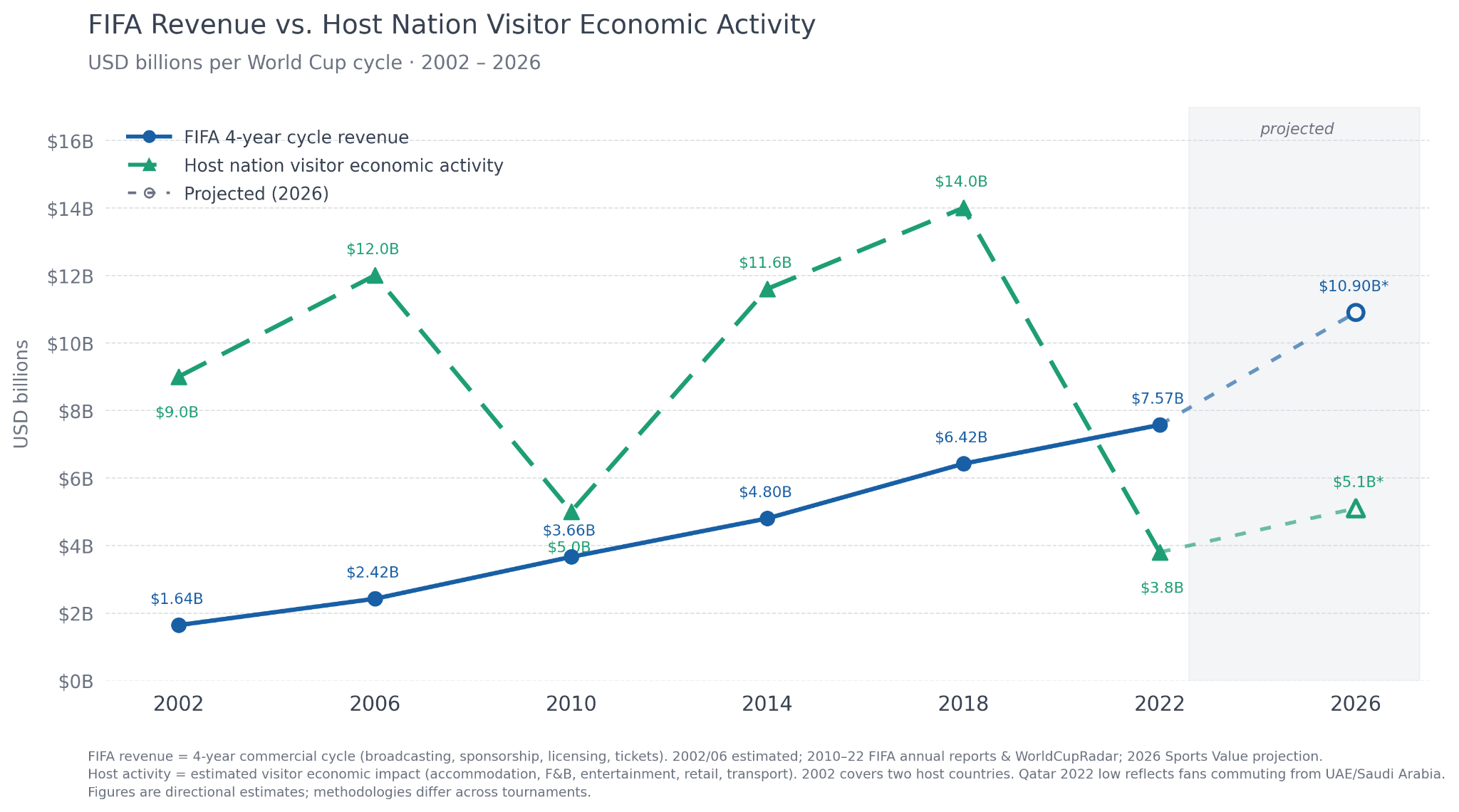
So how does FIFA stay so steady? On paper, it owns the commercial rights, broadcast deals, sponsorship tiers, licensing, and merchandising. Underneath all of that, it owns one element worth far more than the rest.
FIFA devotes the same effort, budget, and attention to the fan who never buys a ticket as to the one who does. It counts everyone who comes through its doors, in person or on a screen, reservation or not. A fan who cannot get into the stadium but flies in to be in the same city as their team is still destination traffic, and FIFA captures the relationship either way.
That leaves host-city hotels fighting over the leftovers: the room nights, the F&B tabs that do not happen inside the stadium, and whatever retail and entertainment they can pull away from sanctioned FIFA venues. Whether any of it clears a positive NOI margin comes down to what happens once a visitor walks through a hotel’s door, before, during, or after a match.
The asymmetry is starkest in time. FIFA engages its fans continuously for the three years between tournaments, the ticket ballot, the merchandise drop, the hospitality package, the official transport, the fan festival, the player Q&A, and beyond.
Many hotels normally engage a guest for a few days before check-in, usually with one generic pre-arrival email, and stop the moment that guest checks out. FIFA’s revenue is emotional, national, and compounding. Hotel revenue is transactional and often accidental; a visitor who wandered into the bar, not a guest the hotel put the right offer in front of at the right moment. That asymmetry is why FIFA’s line is a diagonal, and the host nation’s line is a saw-tooth.
Look at how FIFA treats its own revenue, and the lesson is plain: ticket sales sit in the second tier, beneath the relationship and context FIFA has with every fan. FIFA owns the reason the guest is there: the match, the camaraderie, the national pride, the once-in-a-lifetime memory. Hotels own the room and a handful of ancillaries as long as the visitor walks through their doors: the bar, the café, restaurants, entertainment, the pool, spa, and beyond.
The challenge? What are you going to do to encourage guests to choose your outlets over others? It is rare for a guest’s sole reason to travel to be the hotel itself rather than the destination or the event beside it. Any normal Tuesday at your property works the same way; the World Cup just makes it impossible to ignore.
So why are we continually treating RevPAR as our north star?
RevPAR is not just a metric but something that has hardened into a full decision framework that shapes nearly every commercial, capital, and operating call (CAPEX and OPEX) downstream. When ownership groups and asset managers demand RevPAR performance, every investment that does not move the room rate has to fight for budget against the one number the board has decided matters most. That list is long: better reservation tools, a digital concierge that surfaces ancillary offers, new F&B outlets, spa renovations, a messaging platform that keeps a guest spending inside the building.
Think of it as a football team. RevPAR is your defender: disciplined, reliable, and necessary. It holds the back line and protects a baseline you cannot afford to concede. But no team wins by parking the defence and hoping. A side that only defends draws nil-nil at best and loses on the counter. And right now, with World Cup occupancy soft across every host city, every hotel is chasing the game.
When you are chasing the game, you push players forward. Your forwards, your midfielders, even your sweeper breaking out of the back, those are your ancillary plays. The F&B outlets. The concierge upsell. The experience offer. The perfectly timed message that turns a local watching the match nearby into a paying guest at your bar. These are the players who score margin, and when the room cannot carry the result, they are the ones you commit to moving forward.
Managing to RevPAR as your star forward leaves your best attackers quite literally on the bench, waiting to be called up by the guest if they wander in or you lucked out on social media. It treats the locals filling your café or bar on match day as a lucky deflection rather than a striker you played on purpose. It logs the guest who booked through an Online Travel Agency (OTA), spent nothing beyond the room, and left without a single personalised offer as a clean sheet, when on margin you were actually beaten. It renders the locals, additional guests on a Property Management System (PMS) reservation, and guests at other hotels invisible to you, blind to your offers, and deaf to your brand, simply because they have no reservation.
The World Cup has exposed what was always true on a quiet low-season weekday: the person who visits without a room booking can be worth a lot more than the guest who booked one. What survives this kind of volatility is not a good rate. It is a guest relationship strong enough to justify higher total spend; a relationship extended to every single person who comes through the door.

Valentina is flying from Montevideo with two friends to cheer on La Celeste, Uruguay’s national team, at their first-round match in Miami. She has booked a one-night stay in a penthouse at a luxury beachside hotel.
Two days before she boards, she gets a text, not an email. It is in Spanish, from the hotel, timed to her zone. It asks whether she wants to add anyone to the room for a smoother check-in. She types back two names: her friends, Enzo and Claudia. The hotel builds three individual profiles instead of the single one tied to her reservation. As it turns out, Enzo already has a profile from a stay years ago at a sister property, and a veteran concierge recognises Claudia as one of the most-followed social voices in Uruguay.
Before she boards, the conversation continues over digital messaging. Her flight lands at 22:40; the hotel offers an early arrival, she accepts, and an airport car is arranged. With the car set, the hotel asks whether she is attending any FIFA events while in town and mentions a private tour of Wynwood Walls running alongside a nearby fan festival. It also learns something more useful: she is tired before the flight has even left the ground, and all she cares about right now is checking in.
The context builds. She wants her room first and time to rest before stepping into the event scene. The concierge logs it, the system schedules follow-ups around the tour, the fan festival, and the GM and the VP of Marketing quietly track her and her influential friends through every step of the stay so nothing slips.
The lobby is heaving, an overcommitted turn-of-house weekend ahead. The concierge desk has a short line; the front desk queue has become a full-blown snake. None of it touches Valentina. On the in-flight Wi-Fi, she completed a contactless check-in, ordered a champagne delivery to land after a nap, and booked the salon with her friends to freshen up before the match. Her room key was provisioned straight to her iPhone through her Apple Wallet as a Member Pass, the key art customised to her VIP status and themed for the tournament.
On landing, she shared her digital key with Enzo and Claudia straight from her wallet. Too tired to talk to anyone, she let the front desk look after the guests who did want the human touch. The margin protection here is not sentimental: a guest whose goodwill survives check-in can spend considerably more across the stay.
After the nap, the salon, and the champagne, the mood lifts. Before kick-off, a pre-match dinner is on the table, and a car is booked to the stadium. They make the match. Uruguay wins.
Before Valentina is even back at the hotel, an automated message, timed to the final whistle, invites her party to a celebration table at a poolside fan event, with a bottle of something Uruguayan. She says yes instantly. That night, she spends far more than the entire penthouse rate.
Had Uruguay lost, the message would have been different: quieter, a breakfast offer, something that acknowledged the night without overreaching. The platform read the result and triggered the right message at the right moment. The unified profiles and the concierge tools framed the offers through the digital itinerary in the guest web app. The margin came from knowing what the match meant to her, not from discounting the room to keep her in the building.
Valentina’s profile does not leave with her. Enzo’s and Claudia’s exist now too, enriched by everything they bought in addition to Claudia, whether or not it was tied to Claudia's PMS folio. Their stay taught the hotel what they accepted, declined, and returned to, captured in a single data layer that powers anticipatory service for future guests. When any of them travels again, to this property or another in the portfolio, the conversation picks up where it left off. The behaviours are known; the engagement continues past checkout.
The room was one anchor point among many. The context you hold on every individual who walks through the door is how you reclaim the feeling and refine the relationship into the kind of margin that holds whatever the booking curve looks like six weeks out. A hotel that knows Valentina and her friends at this level does not need to compete on rate to earn the premium, or to win a visit when there is no reservation at all. It only needs to remember who she is.
Knowing Valentina, Enzo, and Claudia that well, and earning margin from every square foot they touch, physical or digital, is what RevPAR was never built to measure.
Before going further, two words need to be redefined.
In Alliants’ terms, a guest is every individual, in person or digitally, who engages with your brand and has any propensity to spend. The locals who are watching the match at your lobby bar. The day visitor in your spa. The person responding to your pre-arrival message who has not yet decided which restaurant to choose. If they can open their wallets and engage, they are guests.
In Alliants' terms, a square foot is any surface a guest engages with, physical or digital. The lobby corner. The guest app. The rooftop terrace. The pre-arrival message thread. The in-room TV menu. The booking website. Each one is real estate you already pay for that is often not used for this kind of focus on margin. Each one can earn better margin beyond what you normally expect if you let it.
That is what's actually worth measuring. Not just the room rate. Not just the keys on the architectural floorplate. The five locals at the bar on a match night. The walk-in browsing your website at midnight in your lobby seating area. The day visitor who walks past your underused lobby corner without anyone offering them a coffee. Every one of them has a propensity to spend, and every one of them is moving across square footage you are already paying to heat, light, and staff.
A familiar hierarchy starts to invert. A 2,000-square-foot lounge filled with locals on a match night will often leave more contribution margin behind than the same suite booked through an OTA or even directly. The commissions, the room-side cost loads, and the fixed-cost allocation never touch the lounge. The underused lobby corner repurposed as a coffee carve-out for the wandering guest, or the generic pre-arrival message turned into a curated relevant upsell, sharpens the comparison further. The terrace that goes dark at 21:00 instead of becoming a weekend pop-up. The guest app sitting idle between check-in and checkout, instead of moving the guest into the spa, the rooftop, or the late dinner table through an interactive itinerary.
Most of the missed margin in a hotel is sitting in space nobody has yet asked to fully earn its keep. Simple isn't easy, of course. Not when the context on every guest, across every space, is fragmented across your tech stack.
Valentina’s experience is an easy example: an ultra-luxury guest, a penthouse, an influential travelling party. That’s a maximum margin goal. Yet, nothing in the model depends on who she is. Strip out the penthouse and the social following, and the same machine runs for everyone who walks through the door and every square foot they touch.
The family of five, after an eight-hour drive, wants to skip the queue, get the children fed, and find a room with a bath rather than a shower, so bath time is not a battle of wills bent on breaking the parents' psyches. The group of friends in for their team's away game wants the watch-party seats held and a fresh round waiting when they arrive.
Different guests. Different offers. Different square feet of the building are being activated. Yet the same context-based strategy, applied with the same care, produces the same result: more margin per square foot, earned through the relationship that curates the space, not the rate.
Here is where the World Cup tells the story plainly. Room rates in host cities are not climbing as forecasted. FIFA has washed the inventory it doesn’t need. Alternative accommodation has flooded in. The supply-and-demand picture for the room itself is softer than the cycle's hype suggested.
Yet the propensity-to-spend picture is the opposite. Every traveller arriving for a match is going to eat, drink, watch, gather, and celebrate, many of them in your city for the first time, all of them with money to put down on the experience. FIFA's official hospitality programme has fenced off the most visible cuts of that total spend: stadium suites, sponsored lounges, branded fan packages. What sits outside the fence of the stadium, like the pre-match dinner, the watch-party that beats the sanctioned watch parties, the after-game cocktail flights, the quiet brunch the morning after the upset, is the larger untapped pool. That gap is yours for the taking, but only if you have stopped measuring the hotel asset by the room alone.
That is the shift. The room is one square foot grouping among many, albeit an important one. RevPAR will always have a place on the team; it holds the line on the rooms you do sell. But the hotels that win the next decade, World Cup year or quiet Tuesday at three o'clock check-in, will be the ones that stop managing RevPAR and start growing NOI across every square foot of the asset. Absolute guest context and knowing how to put it to work beyond the square footage of each guest room are the new key to the result. Whoever owns the relationship owns the margin. Whoever owns the best margin per square foot wins the podium, while everyone else watches you get your flowers.
Chart Source Appendix:
FIFA Revenue (Line 1)
Host Nation Visitor Economic Activity (Line 2)