Room revenue isn't the growth story anymore. HDC 2026 reveals a K-shaped divide between luxury and budget hotels, and where margin is leaking.

At this year's Hotel Data Conference, one theme ran through nearly every session, presentation and conversation on the trade show floor:
ADR and occupancy are no longer the best indicators of where the industry's growth is coming from. It's time to start thinking and acting far beyond the room.
Within all of the data and insights gathered is a single growing trend that underpins everything: a K-shaped bifurcation between the affluent end of the market and everyone else. Luxury and budget hotels are no longer riding the same recovery; they're running two different businesses that happen to share a chain-scale definition.
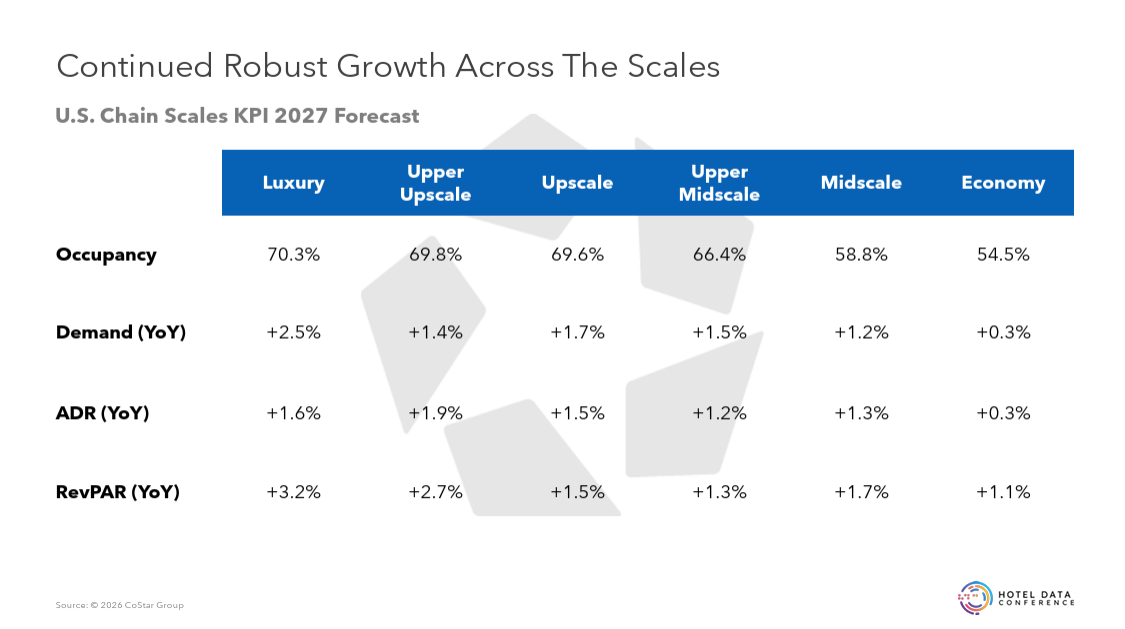
That gap, not any individual stat below, is a growing industry area of focus especially for hotel developers. Here's the data behind that shift, gathered across the conference sessions, presentations, and reports.
Hotel profit margins haven't recovered to their 2019 levels, despite year-over-year revenue growth. They're lower, both per department and overall, than they were seven years ago. Hotels are making more money in raw dollars and keeping a smaller share of each:
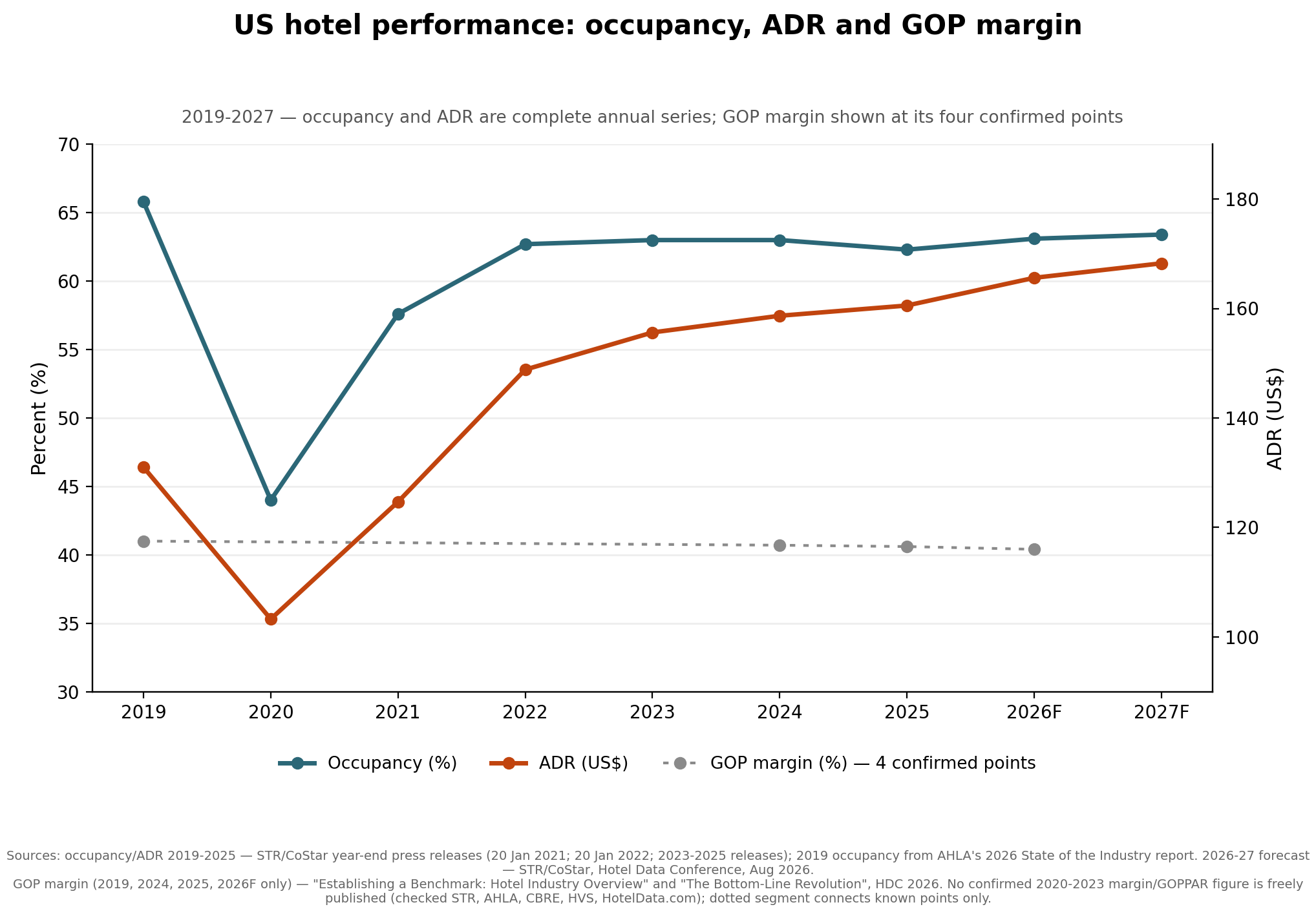
GOP (Gross Operating Profit) has been essentially flat since 2019, and asset owners are still waiting for the net operating income growth that revenue gains were supposed to deliver. A World Cup review delivered at the conference showed exactly why hoteliers need to stop treating room sales as the entire story for success.
Jan Freitag's "Establishing a Benchmark" session put a number on the gap between FIFA's promise and the industry's reality. FIFA had projected the tournament would be worth roughly 104 Super Bowls; at STR's typical Super Bowl room-revenue figure of $108-110 million, that's $11.3 billion in hypothetical room revenue.
The actual figure came in just shy of $680 million, 6% of what FIFA promised. Occupancy still jumped by 20 percentage points in the week before matches, but many properties saw demand closer to a non-event level than the windfall it was desired to be.
Two specific threads sit optimistically underneath the numbers. First, people are willing to travel and spend for the right reasons, tracing back to an experience economy that Forbes estimates at over $1 trillion globally and is on track to exceed $1.2 trillion by 2030. Second, this is the K-shaped bifurcation named earlier, playing out at the microeconomic level: even within a single global event, the affluent end of the market behaved differently from everyone else.
Affluent and/or highly motivated spending is the name of the game as far as any growth metric is concerned for full service hotels. Limited or select service hotels are now in a more focused operational efficiency game. Across multiple sessions that pulled primarily from North American data sets, all insights pointed in the same direction: Once you have your efficiency house in order, you need to pay far more attention to what drives guest spending beyond the room, especially if you target zluxury guests.
All of this points to a single truth hoteliers should carry into fall when the phrase "P&L sheets" becomes commonplace in office meetings: travellers are asking hotel brands, quite literally, for adaptability and flexibility.
Diane Koczur of Evans Hotels described two guest populations booking the same hotel on entirely different clocks, one deciding 72 hours before arrival and the other settling on the trip weeks out: "the booking curve is now defined by channel readiness, not just lead time," she said. Weissend added that no single event behaves like any other, whether it's "a mega concert, a Formula One (race), a college football championship," and that "the traveller who values an experience over a destination is where we're going to see the largest growth."
Demand spikes are increasingly event-driven across all market sizes, from K-Pop supergroups like BTS filling rooms in El Paso Texas to solar eclipses drawing international traffic into towns in Iceland and Northern Europe that never expected it.
Brian Berry, chief commercial officer at Pyramid Global Hospitality, said his team now watches concert and touring calendars, from BTS to Bad Bunny's Puerto Rico residency, "the way they used to watch STR comp sets," because these have become "mega demand drivers." Chris Dickinson of Aimbridge Hospitality added that World Cup demand spilt well beyond the host city: Miami matches pushed travellers into Fort Lauderdale, Orlando and other unexpected regions that got high demand spend.
Capturing a guest for an event is only half the real value now. The other half is capturing their spend once they're inside the destination in the most relevant ways possible, which several operators framed as a design problem rather than an amenities checklist.
Agnelo Fernandes of Cote Hospitality scales experiences for guests rather than selling a single fixed package; Sara Masterson of Olympia Hospitality ties retention to on-site partnerships and programming; Deborah Surden of Expedia Group pointed to the most common failure: resort fees that don't visibly buy any tangible value that guests can name.
None of this shows up in a RevPAR number; it shows up further down the P&L. CBRE's Trends in the Hotel Industry survey confirms the pattern: across its US sample, rooms revenue grew just 1.1% in 2025 against flat occupancy and modest ADR gains, while food and beverage revenue grew 4.3%, driven partly by ancillary income like service charges and meeting-room rental. CBRE itself describes hotels as actively diversifying revenue to offset weak room growth. That means a dedicated focus on margin and ancillary offer opportunities.
The direction is clear even without that number: hoteliers who treat the event calendar as a forecasting input, not a marketing theme, can better time staffing and packaging around demand they can already see coming.
RevPAR is up, and luxury is pulling further ahead, but department profit margins remain below 2019 levels after inflation. Hotels are earning more nominal dollars while keeping a smaller share of each, diminishing Net Operating Income ambitions.
STR's Composite Comp Set, built from asset performance attributes rather than postcode and star rating, exists precisely because geography-and-class comp sets answer "how are we doing versus our neighbours," not "how are we doing versus hotels that behave like us." Which comparison is right depends on what the operator is actually trying to learn.
When prioritising actions like easy revenue gains, discounting, squeezing another shift from an already-thin team, and putting short-term trends over fundamental shifts, you begin to erode margin contribution in ways that require exponential effort to manage or recover from in the long-term.
Core inflation, still above 3%, is expected by Tourism Economics' Adam Sacks to cool through 2027 as the effects of tariffs and energy costs are expected to ease. It hasn't affected travel spending so far, and Sacks doesn't expect that to change: consumer sentiment and consumer behaviour have diverged, and the data backs him up more than the mood in most economic commentary would suggest. As he put it, the two now have "almost no relationship anymore" to each other.
A quieter tidal shift lies beneath: corporate profit strength is uncertain and AI-driven productivity gains aren’t showing the value executives expected. Yet, they are both propping up the same affluent household spending that has carried the industry's growth this year.
International demand is the genuine soft spot, with inbound and Canadian visits down, while American leisure travellers still favour outbound trips to Europe. The counterweight is longer-range: global international travel spending is on track to grow between 8% and 10% a year, according to Tourism Economics' Aran Ryan, a reminder that the current inbound lag looks more like a domestic recovery timing gap than a structural retreat. Labour is the one area where macro data and property-level experience disagree: Ryan's own numbers show no major national shortage, even as recruitment and retention remain genuinely hard on the ground, property by property.
Kelsey Fenerty's closing sessions returned to three traveller archetypes, the Pilgrim, the Professional and the Tourist, each leaving a different booking fingerprint on the same event. National averages can no longer tell an operator what their hotel, market or event will actually do. The tools built for the national and market level need rebuilding at the property level, or they stop being useful.
STR's own phrase for the outlook might be the most useful one to come out of Nashville this year: boring is good. After a World Cup, a shifting affluent traveller base and a K-shaped economy, a forecast with no more surprises would be the real headline because we are entering the era where guest context is quite literally everything to the success of your Net Operating Income levels.